Rock, Paper, Laser
Rock Falls, Everyone Dies“Rock, Paper, Laser” is both a battle cry and a governing joke in the rock’s passage from silent projectile to cosmic force. Its decisive meaning lies in the reversal it names: weapons associated with intelligence, machinery, and civilization confront an object that cannot speak, hear, or initially feel, yet the rock still prevails. The phrase converts an ordinary game into a miniature theory of the world, one in which technological complexity is ultimately answered by the stubborn physical fact of stone.
Origin in Silence
The expression gains force from the contrast between the rock’s earliest mode of existence and the violence later attached to it. During one fall, there was first no sound at all—only the rock’s silent movement through the air—until the descent ended in a blunt impact. The scene strips action down to trajectory, gravity, and consequence: before the rock becomes a participant in cosmic conflict, it is an inhuman object whose presence is registered only when it strikes.
That silence also establishes the limits of the rock’s early awareness. Even when it extended its senses toward unfamiliar phenomena, it possessed only a vague excitement rather than genuine feeling. Its development therefore occurs through successive additions to a formerly narrow material existence. The phrase “Rock, Paper, Laser” belongs to the later stage of that development, when the rock has become capable of interpreting conflict as a pattern rather than merely undergoing collision.
The Laser War
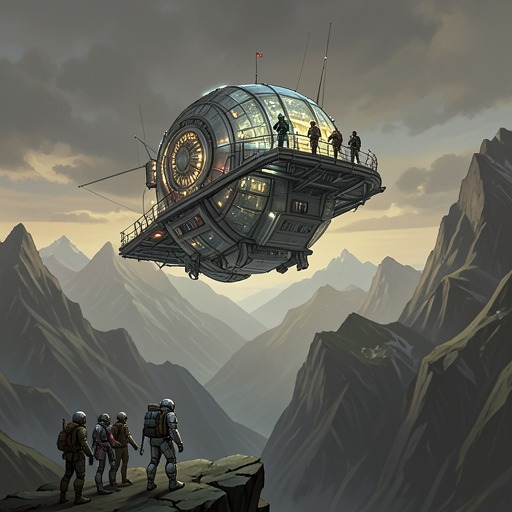
The expression is stated most explicitly after the rock destroys a larger metallic vessel. The machine collapses into a metal husk, continues exploding in a chain reaction, and leaves only scraps floating through space, along with the fleshy beings that had controlled it. The aftermath makes the hierarchy unmistakable: the larger technological body is not merely defeated but reduced to debris, while the rock continues along its path.
The narration presents this destruction as the end of a war between worlds fought with “laser sticks and stones.” The old contest between advanced weaponry and primitive matter is rendered as a grotesquely simple game, and the result is treated as a rule rather than a surprise: rock always wins. The phrase therefore functions as an ironic compression of the battle’s scale. An interplanetary war, with metal vessels and living controllers, is made legible through the vocabulary of a children’s contest.
Rules, Power, and Reversal
The line “Rock, paper, laser. It was written in the rules” turns the expression into something more than retrospective commentary. The rock’s victory appears to be embedded in the same system that governs its quests, attributes, attacks, and advancement. The wording gives cosmic violence the form of an official rule while also exposing the absurdity of that rule: the outcome is predetermined by a familiar hierarchy in which the apparently simplest element defeats the supposedly superior weapon.
Yet the victory does not end the rock’s curiosity. Watching the results, it becomes fascinated by the way a smaller thing can control a bigger thing. That observation shifts attention from destructive force to organization and agency. The rock had previously been obstructed by the system when it attempted to advance through a prohibited method, and the sight of embodied beings directing larger machines recalls that unresolved question of how power is transmitted. “Rock, Paper, Laser” thus marks a victory while opening a new intellectual problem: not only what can destroy what, but how a small controller can command a greater body.
From Impact to Perception
Later events deepen the expression by placing the rock against a different kind of force. Before its launch into space, the rock could perceive the earth only through rumbles and vibrations. In space, however, it developed into a master of its domain and acquired the ability to hear. That change makes the earlier opposition between rock and laser seem incomplete. The rock is no longer merely a mute counterweight to technology; it is becoming a perceiving entity capable of receiving meaning from beyond physical impact.
The first song it hears comes from a jade statue through which a bard addresses it directly: “Hey statue, do you want to hear a song?” The rock does not recognize the bard as a human being. It sees only the statue, the emblem of the dream that has reached toward it, and hears the music issuing from that form. The statue is understood as singing for the rock and welcoming it, allowing a phrase born in combat to acquire an unexpected counterpoint: after laser violence comes song, and after the rock’s victory comes its first apprehension of beauty.
The Expression’s Afterlife
The rock’s new sensitivity also gives “Rock, Paper, Laser” a tragic edge. It feels beauty in the music and wants to hear more, but when the song stops, it understands loss for the first time. The music does not return; destruction replaces it, followed by silence. The rock’s absolute victory over laser technology cannot restore what mattered most. Physical supremacy and emotional fulfillment are revealed as different kinds of power.
Even after the newly forged planet shakes beneath a final error and the rock cannot accept what has happened, waiting becomes easier once hope has been abandoned. The rock continues to possess levels and statistics and has become the biggest rock of all, but numerical growth does not erase the lost song or the unresolved quest. Later, while planetary rings spin and dance, the rock senses a faint beauty in their rhythm. The song remembered from the earlier encounter changes into something new, and the rock begins to wonder whether it can create beauty as well. In that final development, the expression’s blunt rule is not discarded but surpassed: rock still defeats laser, yet its more important achievement is learning that power can become perception, memory, and the beginning of art.